Evaluation · Buying decisions
How to evaluate AI tools for business outcomes
Compare AI tools using your own tasks, correction costs, permissions and reliability instead of a generic model leaderboard.
The short answer
Start with the work
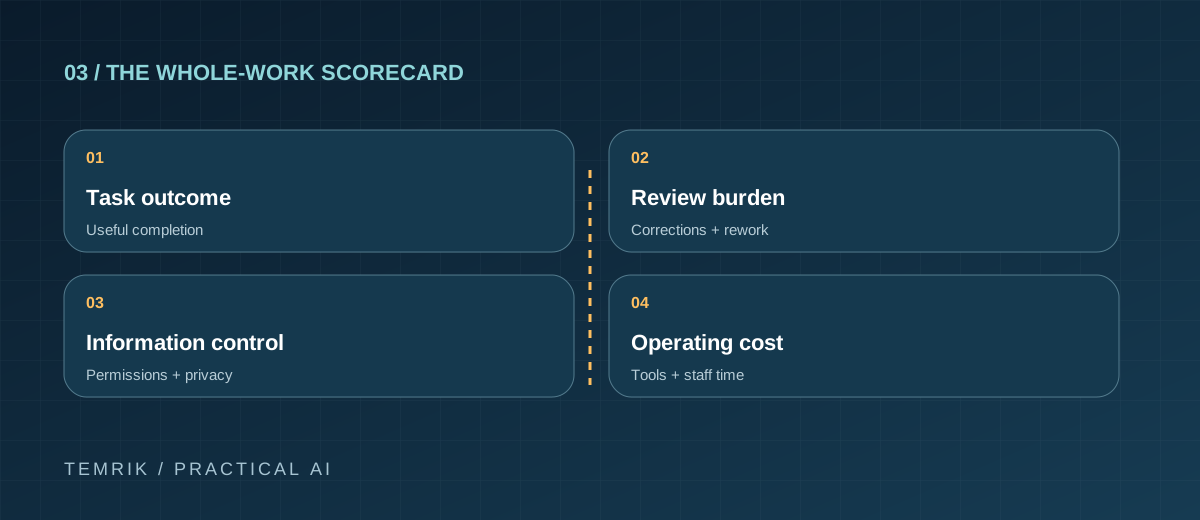
Test candidates on the same real task set and score the entire workflow: useful completion, errors, human correction, cost, privacy and integration effort. A model benchmark is one input; it cannot tell you whether your staff can safely finish their work.
01 / Guide
Build a task set before comparing vendors
Collect examples that represent ordinary work, edge cases and cases the system must refuse or escalate. Remove personal or confidential information unless its use is specifically approved. Write a reference outcome and allow reviewers to mark an answer partly useful, unsupported or unsafe.
Use the same prompt, information and success criteria for each candidate where possible. Keep the version, settings and date with the result so a later retest is meaningful.
- Define success from the user’s completed task.
- Include hard and ambiguous cases, not only ideal inputs.
- Score each candidate independently against the same rubric.
02 / Guide
Count hidden work
Time spent checking, rewriting and repairing integration failures belongs in the cost. A tool can produce fast first drafts while moving more work to senior reviewers. Track rework and escalation by case type rather than averaging away serious failures.
Assess data retention, access controls, region and provider terms against the actual information involved. An attractive answer does not justify sending data to an unapproved destination.
03 / Guide
Make a reversible buying decision
Set minimum thresholds for task quality and information control. Compare total cost over the expected volume, then choose a small rollout with a named owner, review cycle and exit path. Save examples and decisions in a format that can be reused if a better provider appears.
Worked example · illustrative
Example: management reporting drafts
- Situation
- Two tools turn weekly project notes into a management summary.
- Test
- The team tests both on the same eight redacted note sets. Reviewers mark missing actions, unsupported claims, correction minutes and source traceability, then add subscription and integration effort.
- Decision
- Select a tool only if its complete score meets the agreed thresholds. The sample size is illustrative and does not establish statistical performance or any TEMRIK product claim.
Measurement
What to record
Agree a baseline and compare the same categories after the test. Define a minimum acceptable result before seeing the output.
- Useful completed tasks / tested tasks
- Unsupported or consequential errors by type
- Reviewer minutes and rework per task
- Permission fit, implementation effort and total operating cost
Further reading
Primary sources
These external sources inform the general guidance. The worked examples and recommendations above are TEMRIK’s own.
- NIST: AI measurement and evaluation (opens in a new tab)Primary-source context for testing AI against intended use.
- Australian OAIC: commercially available AI products (opens in a new tab)Questions about suitability and personal-information handling.
Work and partner with TEMRIK
Turn a useful idea into a controlled test.
We can discuss your workflow, prepare a scoped pilot and agree what would make a wider implementation worthwhile. Bring a partner opportunity or a business problem; scope and price are agreed before paid work.