Pilot projects · Implementation
How to run an AI pilot project
Plan a bounded AI pilot with a real workflow, acceptance criteria, human review, and a clear continue or stop decision.
The short answer
Start with the work
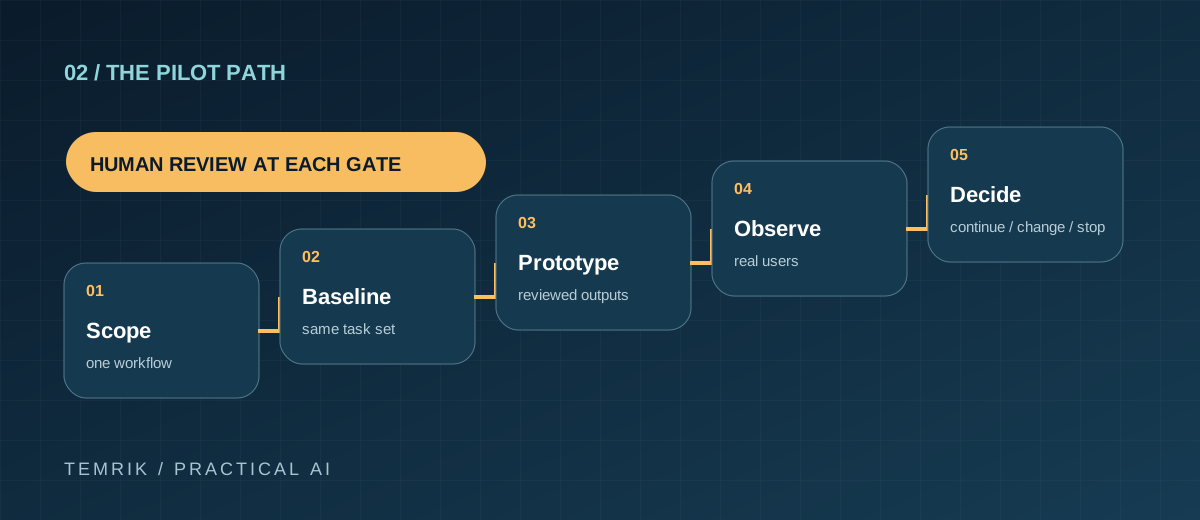
A useful pilot tests one workflow with its users, a baseline, an approved task set and a decision date. It should reveal whether the proposed process is better in practice, including the cost of review and errors.
01 / Guide
Write a one-page pilot charter
Describe the triggering event, inputs, desired output, users, review authority and permitted data. Decide which actions the pilot may prepare and which remain manual. Assign an owner who can stop the test if quality or information handling fails.
Define a task set that includes normal cases, incomplete inputs and cases that should be escalated. Record the current process on that same set. Do not select only the easiest examples to make the prototype appear successful.
- State the hypothesis and baseline measure.
- Set the allowed data, reviewers, budget and test period.
- Define failure conditions and a manual fallback.
02 / Guide
Observe actual work
A prototype that looks good in a presentation can still interrupt the people using it. Watch representative staff try to complete the full task: find the source, understand the suggestion, correct mistakes and finish the record. Capture where they hesitate and what they distrust.
If customer-facing material is involved, a trained person approves it before release. Keep the pilot distinguishable from a deployed service and avoid silent changes to live systems.
03 / Guide
Decide on evidence, not enthusiasm
Compare the same task categories before and after the pilot. Include preparation time, checking time, errors, rework and operating expense. Record unexpected cases and who resolved them. A continue decision should name the next boundary, responsible person and monitoring plan; a stop decision should preserve what the team learned.
Worked example · illustrative
Example: enquiry intake
- Situation
- A property team repeatedly asks for missing details before an enquiry can reach the right person.
- Test
- The pilot extracts address, request type and missing fields from a small consented or synthetic sample. A staff member checks each extraction and sends any follow-up personally.
- Decision
- Advance only if missing-information detection improves without unacceptable misrouting or longer total handling time. The example is a proposed test, not a deployed TEMRIK result.
Measurement
What to record
Agree a baseline and compare the same categories after the test. Define a minimum acceptable result before seeing the output.
- Complete cases routed correctly
- Total staff minutes per case
- Incorrect or unsupported suggestions
- Cases needing escalation and time to resolve them
Further reading
Primary sources
These external sources inform the general guidance. The worked examples and recommendations above are TEMRIK’s own.
- NIST: AI Risk Management Framework Playbook (opens in a new tab)Voluntary govern, map, measure and manage guidance.
- UK Government: SME Digital Adoption Taskforce update (opens in a new tab)Describes a test-and-learn approach to digital adoption pilots.
Work and partner with TEMRIK
Turn a useful idea into a controlled test.
We can discuss your workflow, prepare a scoped pilot and agree what would make a wider implementation worthwhile. Bring a partner opportunity or a business problem; scope and price are agreed before paid work.